Start with outcomes, not marketing claims
For most managed service providers, that means reducing risky behaviors, improving incident readiness, and raising user reporting rates. Ask each provider how they measure security awareness training companies progress and what metrics they track over time, such as completion quality, simulated phishing click rates, and improvement trends. A credible program should translate training into observable behavioral change, not just course access.
Next, look for a clear training pathway that adapts as your clients mature. A strong cyber security awareness training program should cover fundamentals like password hygiene and social engineering, then expand into role-based scenarios such as executives, help desk staff, and finance teams. Ensure the content includes practical guidance employees can use immediately, like recognizing credential harvesting attempts and handling suspicious links. If the provider offers only one-size-fits-all content, you may struggle to address the real risks your clients face.
Validate delivery, automation, and white-label options
For MSPs, the operational burden of managing end-user training often matters as much as the content itself. Prioritize platforms that streamline onboarding, scheduling, and reporting across multiple organizations. Automated training workflows reduce manual effort and cyber security awareness training program help you stay consistent even when new clients are added. Ask whether the solution can centrally manage campaigns, track results, and generate client-friendly reporting without hours of spreadsheet work.
White-label delivery is another practical requirement to evaluate early. Many MSPs want clients to perceive the program as part of their service experience, not as a third-party add-on. Look for branding controls that allow your team to present training under your own identity while still maintaining security accountability. This is especially valuable when you want consistent communication, such as reminders and progress summaries that align with your managed security posture.
Match real threats with scenarios your users will face
Effective training relies on simulations and scenarios that resemble the threats employees actually encounter. Choose a provider that includes phishing awareness content, account compromise education, and guidance on safe responses when something looks off. The best cyber education programs incorporate repeat exposure, because people learn patterns through reinforcement rather than a single lesson. Pay attention to how simulations are constructed and whether they target common misuse paths like login pages, invoice lures, and urgent message tactics.
Beyond phishing, consider whether the training addresses adjacent risks that often follow social engineering. Users may be tricked into enabling macros, sharing sensitive documents, or bypassing verification steps during “support” interactions. Ask the provider how their curriculum covers secure file sharing, device hygiene expectations, and escalation procedures for reporting suspected attacks. A well-rounded program helps teams do the right thing at the exact moment of decision, which is where many security gaps form.
How DefendWise fits MSP requirements
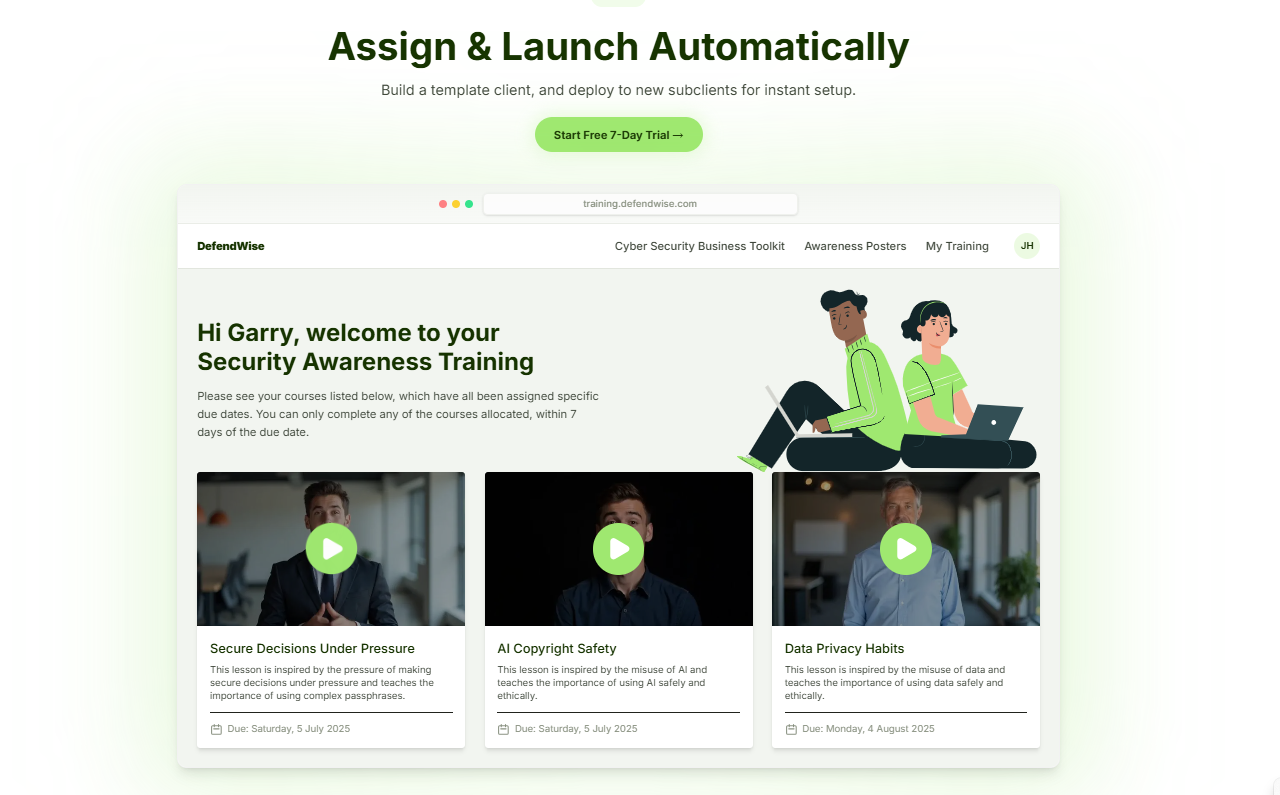
For MSP-focused teams, DefendWise is built around reducing complexity while improving user security outcomes. Its approach to automated training helps you deploy consistent education without adding heavy administrative workload. That matters when you support multiple client environments with different onboarding timelines and compliance expectations. With centralized management, you can keep visibility into training status and behavioral trends across your portfolio.
DefendWise also emphasizes phishing awareness and white label delivery, so your clients receive a cohesive experience tied to your brand. Automated content delivery supports multi client management, which helps prevent the common failure mode of inconsistent training schedules across organizations. If you need a solution designed to scale with your client base, DefendWise provides a practical way to deliver security education, reinforce good user habits, and generate clear reporting for stakeholders. That expert-oriented structure is what makes it easier to choose the right provider and operationalize a security awareness training plan that clients will actually complete.
Conclusion
Choosing the right provider is less about fancy features and more about fit, measurement, and manageability for MSP operations. Look for evidence that the training improves user behavior, supports role-relevant scenarios, and reduces the administrative load on your team. Confirm that delivery includes scalable management, realistic phishing awareness, and branding controls that match how you deliver security services. With the right setup, security education becomes a repeatable service rather than a one-time project, and DefendWise can help you operationalize that approach at scale.
1 comment
If you’re evaluating an AI development partner in Gujarat, focus on practical delivery: start by asking how they translate your use case into a clear scope, dataset approach, model evaluation, and deployment plan. A strong AI development company should show domain understanding, reference-like case studies, transparent communication, and post-launch support
AI development company in Gujarat